What Is League of Legends?
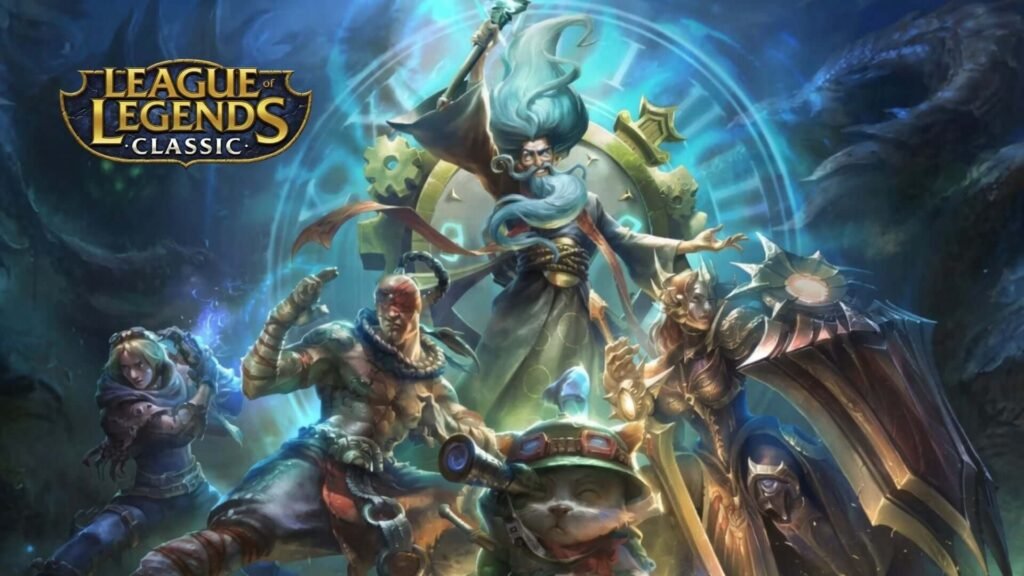
League of Legends is a free-to-play multiplayer online battle arena (MOBA) developed by Riot Games. The game features two teams of five players competing to destroy the opposing team’s Nexus while managing lanes, objectives, champions, items, and team fights.
The main experience revolves around Summoner’s Rift, where players select champions with different abilities and roles before entering a competitive 5v5 battle. Riot describes the game as a team-based strategy experience centered around destroying the enemy Nexus.
League of Legends combines fast combat with strategy, map awareness, resource management, teamwork, and champion mastery. A match can change dramatically from one decision, making positioning and objective control just as important as getting eliminations.
How Does League of Legends Gameplay Work?
A standard Summoner’s Rift match consists of two teams of five players. Each player controls one champion and normally occupies one of five primary positions:
- Top Lane
- Jungle
- Mid Lane
- Bot Lane
- Support
The objective is straightforward: destroy the enemy Nexus before the opposing team destroys yours.
However, reaching the Nexus requires teams to manage multiple layers of the map. Players fight enemy champions, clear minion waves, destroy turrets, collect gold and experience, secure jungle objectives, and coordinate team fights.
Riot’s official beginner guide explains that turrets and inhibitors protect the route toward the Nexus, while jungle objectives such as Drakes and Baron Nashor can provide important advantages.
League of Legends Champions
Champions are the heart of League of Legends. Each champion has a unique ability kit, strengths, weaknesses, and preferred playstyles.
Riot’s current champion roster contains more than 170 champions, giving players a huge range of options.
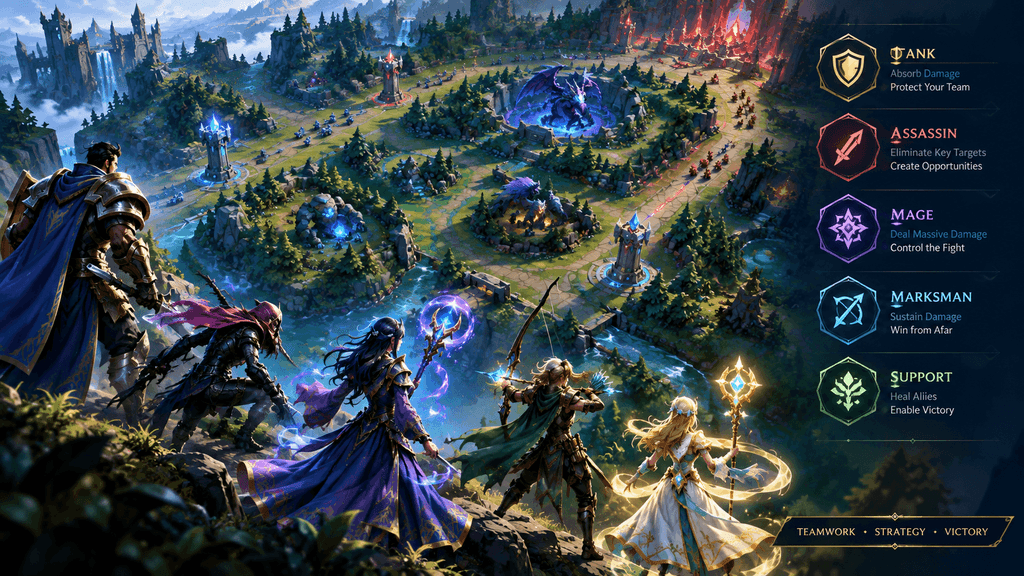
Champions are commonly associated with six broad classes:
Assassins
Assassins specialize in quickly eliminating vulnerable targets. They often rely on mobility, burst damage, and positioning.
Fighters
Fighters combine damage and durability, making them effective in extended combat. They are often comfortable fighting on the frontline.
Mages
Mages generally rely on powerful abilities, magic damage, crowd control, or area-of-effect attacks.
Marksmen
Marksmen typically deal sustained damage through ranged basic attacks. Their positioning becomes especially important during team fights.
Supports
Supports help their team through healing, shielding, crowd control, vision, protection, or offensive setups.
Tanks
Tanks are designed to absorb damage and create opportunities for their teammates. Many have crowd-control abilities that can influence team fights.
These classifications are useful for beginners because they provide a quick way to understand how different champions approach combat.
Understanding the Five League of Legends Roles
Choosing a role is one of the first major decisions a new player makes.
Top Lane
Top lane generally features champions that can operate independently for significant portions of the early game. Fighters, tanks, and other durable champions are common choices.
Top laners need to understand wave management, trading, positioning, and when to join fights outside their lane.
Jungle
The jungler moves between the lanes and clears neutral monsters while looking for opportunities to help teammates.
Jungle gameplay requires strong map awareness because the jungler can influence multiple areas of the map. Tracking objectives and understanding when to gank or farm are important skills.
Mid Lane
Mid lane often features champions capable of dealing significant burst or sustained damage.
Because the lane sits near the center of the map, mid laners can potentially influence fights in both the upper and lower portions of the Rift.
Bot Lane
The bot lane is commonly occupied by a marksman alongside a support.
The marksman’s primary goal is generally to become a strong source of sustained damage, while the support helps create opportunities, protect teammates, and control vision.
Support
Support players contribute without necessarily being the team’s primary damage source.
Depending on the champion, a support may provide crowd control, protection, healing, vision, or engage potential.
For new players, understanding the purpose of each role is often more valuable than immediately trying to master every champion.
Why Gold and Experience Matter
Two fundamental resources in League of Legends are gold and experience.
Experience allows champions to level up and strengthen their abilities and statistics. Gold is used to purchase items that increase a champion’s effectiveness.
Players can gain resources through activities such as defeating minions and champions, assisting in kills, and destroying structures.
This creates an important strategic concept:
Winning fights is useful, but converting advantages into resources and objectives is what helps close games.
For example, getting a kill and then returning to lane may provide less long-term value than using that opportunity to push a wave, damage a turret, secure an objective, or establish vision.
Summoner’s Rift Objectives
League of Legends isn’t simply about defeating enemy champions.
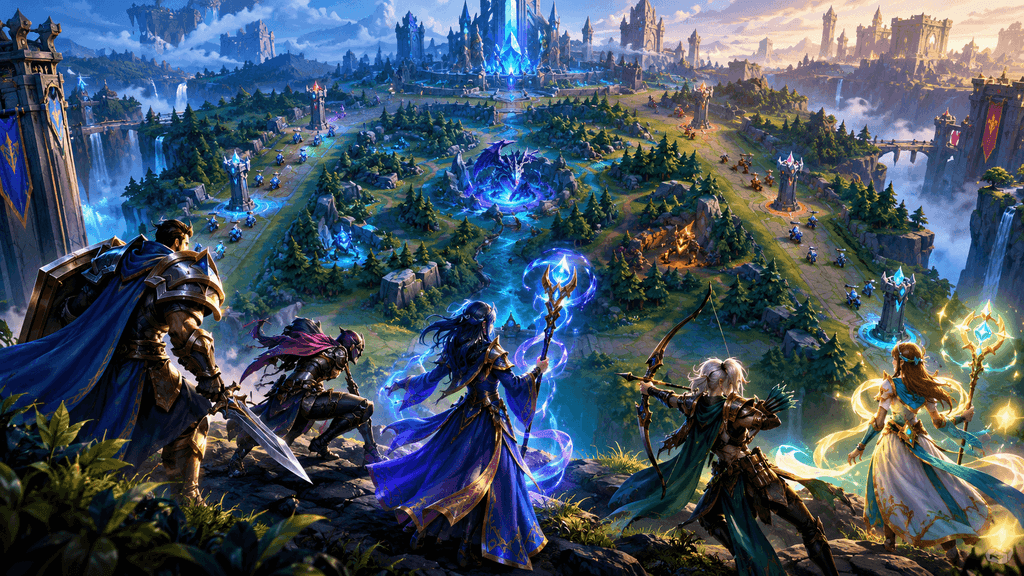
The map contains objectives that can influence the outcome of a match.
Turrets
Turrets defend lanes and protect access to deeper parts of the enemy base.
Destroying turrets opens the map and creates more opportunities for your team.
Inhibitors
Inhibitors are important defensive structures positioned deeper inside each base. Destroying one can create additional pressure on the opposing team.
Drakes
Drakes are major jungle objectives that can provide team-wide benefits.
Teams frequently fight around these objectives because controlling them can improve their position as the match progresses.
Baron Nashor
Baron Nashor is one of the most important neutral objectives on Summoner’s Rift. Riot’s official guide notes that defeating Baron provides powerful benefits, including stronger nearby minions and additional combat-related advantages.
Because Baron can dramatically improve a team’s ability to push, both teams need to carefully consider vision and positioning around the area.
League of Legends Team Fights
Team fights are some of the most exciting moments in League of Legends, but simply attacking the nearest enemy isn’t always the right approach.
A successful team fight can depend on:
- Positioning
- Target selection
- Cooldown management
- Crowd control
- Vision
- Champion abilities
- Item power
- Timing
- Communication
One of the biggest beginner mistakes is entering a fight without considering whether important abilities are available.
Before engaging, ask:
Do we have enough health?
Are our major abilities ready?
Where is the enemy jungler?
What objectives are nearby?
Can our team follow the engage?
These questions can prevent many unnecessary deaths.
Beginner Tips for League of Legends
1. Start With a Small Champion Pool
You don’t need to learn dozens of champions immediately.
Choose a few champions that fit your preferred role and spend time learning their abilities, strengths, weaknesses, and common matchups.
2. Learn to Farm
Minions are an important source of gold and experience.
Improving your ability to safely collect minions can have a major impact on your champion’s strength throughout a match.
3. Watch the Mini-Map
Map awareness is one of the most valuable skills in League of Legends.
Regularly checking the mini-map can help you identify missing enemies, potential ganks, objective threats, and opportunities to help teammates.
4. Don’t Chase Every Kill
A low-health enemy can be tempting, but chasing too far can turn an advantage into a disaster.
Sometimes taking a turret, securing an objective, or resetting safely is more valuable than pursuing another elimination.
5. Learn From Deaths
Instead of simply blaming a teammate or opponent, ask why the death happened.
Were you too far forward?
Did you miss enemy vision?
Were important abilities unavailable?
Did you fight while behind?
Understanding the reason behind a mistake makes it easier to avoid repeating it.
6. Focus on Objectives
Kills are only one part of League of Legends.
Turrets, inhibitors, Drakes, Baron, minion waves, and map control all contribute to winning.
A team that consistently converts successful plays into objectives can create much more pressure than a team focused exclusively on kills.
7. Learn One Role at a Time
League of Legends has a large amount of information to absorb.
Rather than trying to master every position simultaneously, concentrate on one primary role and learn its fundamentals.
Once you understand your main role, learning another position becomes easier.
👉AION 2: Everything You Need to Know About NCSOFT’s New MMORPG
League of Legends Game Modes
Summoner’s Rift is the core competitive experience, but League of Legends also offers additional ways to play.
The official League website currently highlights Summoner’s Rift, ARAM, ARAM: Mayhem, and Teamfight Tactics among its available experiences.
Different modes can serve different purposes.
Summoner’s Rift is ideal for learning traditional League strategy, while ARAM offers a more concentrated team-fighting experience.
For players who want something different, Riot has also introduced special experiences and returning content as part of its ongoing 2026 development plans.
League of Legends in 2026
League of Legends continues to evolve through balance updates, gameplay changes, new content, and experimental features.
Riot’s 2026 development plans have included changes designed to make different roles feel more impactful while encouraging strategies beyond constant team fighting, including greater emphasis on split pushing and sieging.
The game is therefore not static. Champion balance, items, objectives, systems, and strategies can change over time.
For players following competitive or ranked play, keeping up with the latest patch notes is an important part of staying informed.
Is League of Legends Worth Playing?
League of Legends offers a deep competitive experience for players who enjoy strategy, teamwork, character variety, and skill-based progression.
Its large champion roster means players can experiment with different playstyles, while the game’s strategic depth gives experienced players plenty of room to improve.
The learning curve can be significant, particularly for newcomers, but starting with a small champion pool and focusing on fundamentals makes the experience much easier to understand.
Whether you enjoy aggressive combat, strategic map control, supporting teammates, or mastering individual champions, League of Legends provides multiple ways to approach the game.
👉FC 27 Ultimate Team Beginner Guide: Build Your First Squad
Final Thoughts
League of Legends remains one of the most recognizable multiplayer games in the MOBA genre because it combines accessible objectives with a deep strategic system.
For beginners, the best starting point is simple: learn your role, understand your champion, farm consistently, watch the map, respect objectives, and focus on improving one mistake at a time.
Once those fundamentals become familiar, you can begin exploring advanced concepts such as wave management, jungle tracking, champion matchups, itemization, vision control, macro strategy, and coordinated team fights.
League of Legends has a lot to learn, but that depth is also what keeps each match challenging and gives players plenty of opportunities to improve.