

Choosing the right class in Fire Emblem: Fortune’s Weave can dramatically change how a unit performs on the battlefield. The game uses multiple class tiers, with different options specializing in weapons, magic, defense, mobility, and tactical utility. Nintendo has confirmed Beginner, Specialty, and Advanced classes, while certification is tied to developing the skills needed for different roles.
There is no official Nintendo “best class” ranking, so the list below focuses on practical battlefield value rather than treating any tier list as definitive. For most teams, flexible classes that provide reliable damage, mobility, defense, or magic coverage are the easiest to build around.
Quick answer: The strongest class choices depend on the job you need filled. Offensive classes such as Gladiator provide dependable frontline pressure, Diviner gives teams access to magic, Ornius Rider provides mobility, while Advanced options such as Cataphract and Guardian specialize in durability and magical support. There is no single class that is best for every unit or every map.
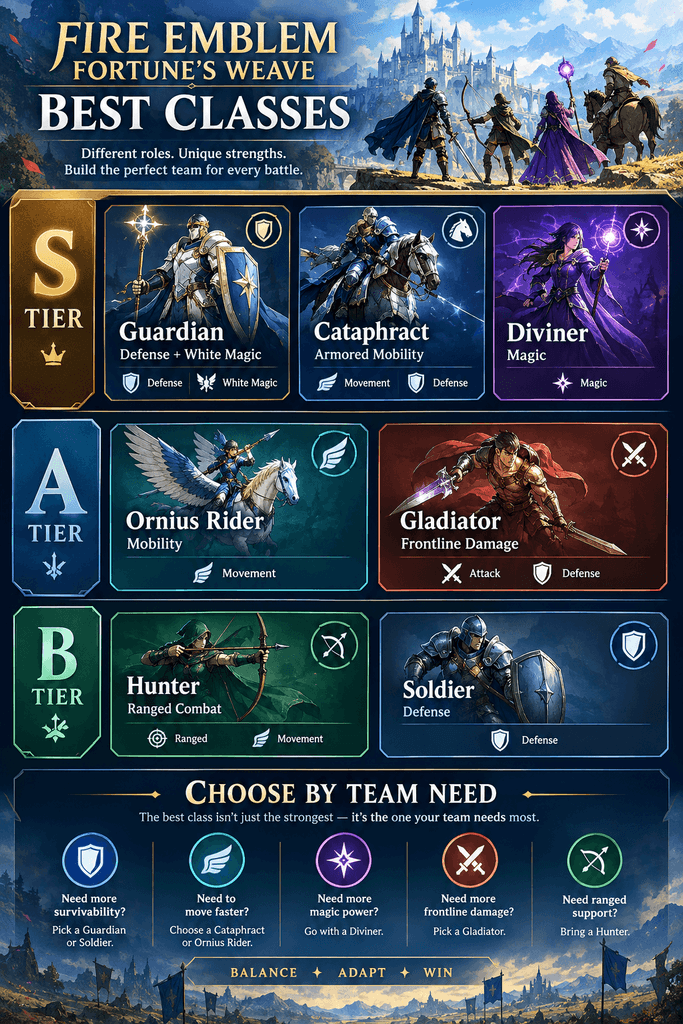
Fire Emblem: Fortune’s Weave Class Tier List
The following ranking is a practical guide rather than an official Nintendo tier list. It considers the usefulness of a class’s role, battlefield flexibility, mobility, survivability, and the problems it can solve during tactical battles.
| Tier | Class | Primary Role | Why It Stands Out |
|---|---|---|---|
| S | Guardian | Defense / Magic Support | Combines strong defensive utility with White Magic and spear access. |
| S | Cataphract | Armored Cavalry | Combines heavy protection with mounted mobility. |
| A | Diviner | Magic | Provides an important magical option for teams that need attacks outside normal physical weapons. |
| A | Ornius Rider | Mobile Cavalry | Provides greater movement and access to multiple physical weapon options. |
| A | Gladiator | Frontline Damage | A flexible early combat class suited to close-range physical fighting. |
| B | Hunter | Ranged / Skirmisher | Useful for Dexterity, Speed, and ranged combat. |
| B | Soldier | Defense | Useful when a team needs a durable frontline unit. |
| B | Wing Soldier | Flying Mobility | Flying movement can provide valuable access to difficult terrain and objectives. |
Class names and broad roles above are based on currently documented Fortune’s Weave class information. Nintendo’s public material confirms the major class structure and several representative classes, while more detailed community databases should be treated cautiously when they make claims that cannot be independently confirmed.
What Makes a Class Good in Fortune’s Weave?
The best class is not necessarily the one with the highest theoretical statistics. Tactical RPG battles reward different characteristics depending on the map, enemy composition, objectives, terrain, and the rest of your roster.
1. Battlefield Role
Start by asking what your team is missing. A group already containing several physical attackers may benefit more from a magical or support-oriented class than another melee damage dealer.
2. Weapon Access
Class selection affects the type of combat a unit can specialize in. Developing a unit toward a class that complements its existing weapon training is generally more efficient than forcing an unrelated role.
3. Movement
Movement can be as important as raw damage. Cavalry and flying classes can reach objectives, reposition around enemies, and respond to threats more quickly than conventional infantry.
4. Survivability
A high-damage unit that cannot safely remain in combat can be difficult to use. Defensive classes become especially useful when a map requires holding a position or protecting weaker allies.
Best Advanced Class for Defense: Guardian
Guardian is one of the most attractive Advanced options for players who want a defensive unit that can also contribute magical utility.
Public coverage of the August Nintendo Direct describes Guardians as Advanced classes skilled with White Magic and spears. That combination gives the class a distinct role compared with a purely physical frontline fighter.
Why Choose Guardian?
- Combines defensive battlefield utility with magic.
- Provides an alternative to purely physical frontline classes.
- Can contribute to team sustain while remaining relevant in combat.
- Works well when your roster needs both durability and support.
Guardian is particularly attractive when your formation needs a unit that can stay near the frontline without sacrificing all access to utility.
Best Advanced Class for Heavy Frontline Units: Cataphract
Cataphract is designed around the combination of armor and mounted movement. Nintendo’s Direct coverage specifically describes Cataphracts as heavily armored while retaining horse-based mobility.
This combination can solve one of the classic tactical problems in strategy RPGs: a durable unit may struggle to reach the part of the map where it is needed. Mounted movement helps reduce that weakness.
When Cataphract Makes Sense
- You need a durable frontline unit.
- The map rewards movement and repositioning.
- Your team already has enough magical support.
- You want a physical tank that can keep pace with mobile allies.
Best Magic Class: Diviner
Diviner is one of the important Beginner classes because it establishes a magical combat path from the early game.
Nintendo’s Direct presentation identifies Diviners as magic-oriented units, while coverage of the presentation notes their connection to Reason and Faith magic.
For a balanced team, having access to magic gives you another way to approach enemies that may be less convenient to defeat with purely physical attacks.
Why Magic Coverage Matters
- Provides an alternative to physical damage.
- Allows your roster to cover different enemy defenses.
- Creates more flexibility when positioning attackers.
- Helps prevent an overly physical team composition.
Best Mobile Class: Ornius Rider
Ornius Rider is one of the most useful mobility-focused options. Nintendo’s presentation describes the class as a mounted option with increased movement, and coverage of the Direct identifies its ability to move across low obstacles.
Mobility matters when an objective is located far from the main battle or when enemies can punish slow units for arriving too late.
Advantages of Ornius Rider
- Higher movement than standard infantry.
- Useful for repositioning around the battlefield.
- Can help reach objectives faster.
- Offers a different tactical profile from stationary frontline units.
The class is especially useful for players who prefer aggressive positioning and rapid responses rather than building a team entirely around a fixed defensive line.
Best Beginner Frontline Class: Gladiator
Gladiator is a strong foundation for close-range physical combat. The class is documented as specializing in swords, axes, and gauntlets and is intended to function as a frontline fighter. :contentReference[oaicite:8]{index=8}
Its main advantage is straightforward: it gives a unit a reliable physical combat identity without requiring an unusually complicated strategy.
Gladiator Strengths
- Strong close-range focus.
- Multiple physical weapon options.
- Useful foundation for physical combat development.
- Easy to understand for newer players.
Best Ranged Beginner Class: Hunter
Hunter provides a different approach by emphasizing ranged combat and skirmishing. Nintendo Direct coverage describes the class as having a focus on Dexterity and Speed, while also identifying its bow specialization.
Ranged units can contribute damage without standing directly on the frontline, making them valuable when the map contains dangerous melee enemies.
Best Defensive Beginner Class: Soldier
Soldier is the natural choice when the immediate requirement is a sturdier physical frontline.
Public coverage of the Nintendo Direct describes Soldiers as infantry/armored units with high Defense and proficiency centered on weapons including the lance and axe. :contentReference[oaicite:10]{index=10}
Soldier is therefore a useful foundation when your roster needs someone who can withstand pressure rather than simply maximize offensive output.
How to Choose the Right Class for Your Unit
Instead of automatically copying a tier list, use the following process when building a character.
- Identify the unit’s current role. Decide whether the character is primarily a damage dealer, tank, ranged attacker, mage, or support unit.
- Check available class options. Look at the certification options currently available to that character.
- Consider weapon development. Favor a class that makes use of skills and weapon training the unit is already developing.
- Check your team composition. Avoid creating five units that perform the same battlefield job.
- Consider movement. Mobile classes can be particularly valuable on maps where positioning is difficult.
- Consider the map objective. A defensive class can be more useful on a survival objective, while mobility may matter more when reaching multiple objectives.
Beginner vs. Advanced Classes
Do not assume that an Advanced class is automatically better for every situation. Class progression is about specialization, and a simpler class can still be useful if its role fits your current team.
| Class Tier | Best Use | What to Consider |
|---|---|---|
| Beginner | Establishing a basic combat role | Useful for developing the foundation of a unit. |
| Specialty | More focused tactical roles | Choose according to the unit’s developing strengths. |
| Advanced | Specialized high-level roles | Consider the team’s overall composition before committing. |
Nintendo’s Direct presentation confirms the three publicly documented tiers and describes Specialty classes as more specialized options, while Advanced classes represent more developed versions of particular combat roles.
Common Class-Building Mistakes
Choosing a Class Only Because It Is Higher Tier
A higher-tier class is not automatically the right answer. A class should solve a tactical problem for your roster.
Ignoring Team Balance
If every unit is built for close-range physical combat, your team may lack the flexibility needed for certain maps. Mix physical, magical, ranged, defensive, and mobile roles when appropriate.
Forcing a Unit Into an Unrelated Role
Class changes should make practical use of a unit’s development. Moving a character into a completely different role can require additional investment and may not improve the team.
Ignoring Movement
Movement can determine whether a unit reaches an objective in time. Do not judge a class solely by its offensive potential.
➡Aetheria Rising Our Honest Verdict on 2025’s Most Hyped RPG
Recommended Class Choices by Playstyle
| Playstyle | Classes to Consider | Primary Reason |
|---|---|---|
| Aggressive melee | Gladiator | Close-range physical pressure. |
| Magic-focused | Diviner | Magic access and ranged magical attacks. |
| Mobile | Ornius Rider | Improved movement and positioning. |
| Ranged | Hunter | Bow-focused skirmishing. |
| Defensive | Soldier / Cataphract | Frontline durability. |
| Defense + support | Guardian | White Magic and spear-based utility. |
Are There Any Classes You Should Always Use?
No. Fire Emblem: Fortune’s Weave rewards adapting your team to the tactical situation rather than following one universal class formula.
The strongest approach is to maintain coverage across several battlefield roles. A balanced team can combine a durable frontline, a ranged attacker, a magical unit, and at least one mobile option instead of putting every character into the same type of class.
Quick Class-Building Checklist
- □ Identify the unit’s primary battlefield role.
- □ Check which certifications are currently available.
- □ Consider the unit’s existing weapon development.
- □ Check whether your team lacks magic, range, defense, or mobility.
- □ Consider the map objective before changing classes.
- □ Avoid copying a ranking without considering your own roster.
- □ Reassess the build when a unit’s role or team composition changes.
➡ Slayers 2 Clan Tier List: Every Clan Ranked
Frequently Asked Questions
What is the best class in Fire Emblem: Fortune’s Weave?
There is no single universally best class. Guardian and Cataphract are particularly useful for specialized defensive roles, while Diviner, Ornius Rider, and Gladiator cover magic, mobility, and frontline combat. The best choice depends on the unit, map objective, and needs of your team.
How many class tiers are in Fortune’s Weave?
Nintendo’s publicly presented class structure includes Beginner, Specialty, and Advanced classes. The Beginner tier establishes core combat roles, Specialty classes provide more focused options, and Advanced classes develop specialized battlefield roles further.
Is Diviner good in Fortune’s Weave?
Diviner is useful when your team needs magical combat. It gives players a clear alternative to building a roster entirely around physical weapons and can provide valuable flexibility against different enemy types.
Is Ornius Rider worth using?
Ornius Rider is particularly useful for players who value mobility. Its mounted movement can help units reposition quickly and reach objectives that are difficult for conventional infantry to access. :contentReference[oaicite:13]{index=13}
Is Gladiator good for beginners?
Gladiator is an accessible physical combat option because its role is easy to understand: it focuses on close-range fighting with swords, axes, and gauntlets. It can provide a straightforward foundation for players learning the game’s class system.
Should every character use an Advanced class?
No. Advanced classes offer specialized roles, but class choice should depend on your team’s requirements and the unit’s development. A lower-tier class can still be appropriate when it provides the weapon access, role, or tactical function your team needs.
Does class choice matter in Fortune’s Weave?
Yes. Classes influence how units approach combat and interact with weapons, movement, magic, defense, and other tactical systems. Choosing complementary classes helps create a team capable of handling different battlefield situations.
Does Nintendo provide an official best-class tier list?
No. Nintendo’s public materials explain the class system and showcase specific classes, but they do not provide an official S-to-D ranking of the game’s classes. Any ranking should therefore be understood as an editorial or community recommendation rather than an official Nintendo classification.
Conclusion
The best classes in Fire Emblem: Fortune’s Weave depend on the role your team needs most. Guardian and Cataphract stand out for specialized defensive roles, while Diviner, Ornius Rider, Gladiator, Hunter, and Soldier provide important magical, mobile, offensive, ranged, and defensive foundations.
Rather than building around a single tier-list favorite, look at your unit’s development and your current battlefield needs. A balanced roster with complementary roles will give you more tactical options throughout the game.
Next step: Review your current roster, identify its biggest weakness, and choose your next class certification to address that specific gap.