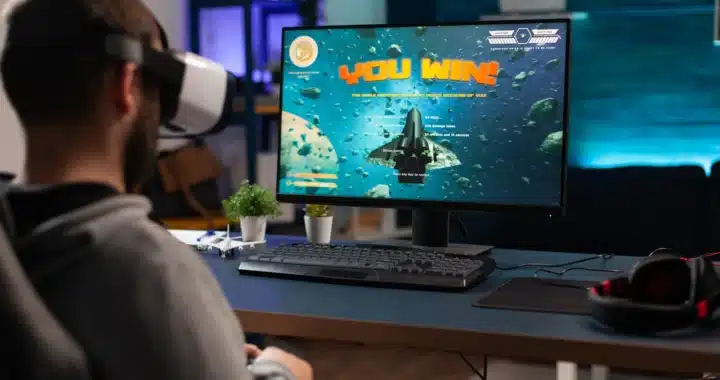

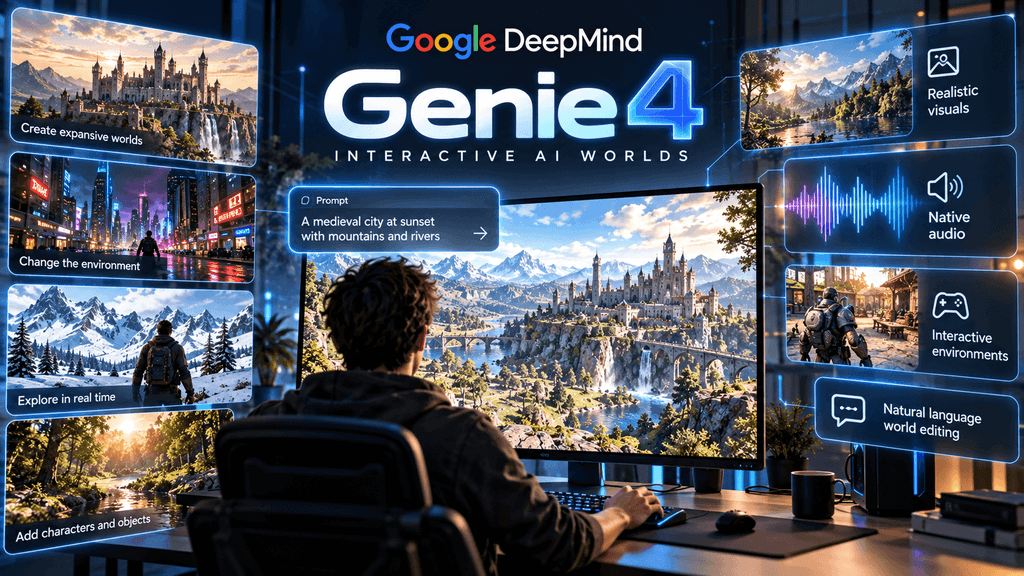
Google DeepMind has introduced Genie 4, a new artificial intelligence world model capable of generating interactive virtual environments with realistic visuals, native audio, and real-time changes controlled through natural language.
Announced on October 27, 2026, Genie 4 represents a major step in Google’s research into AI-generated simulations. The technology also raises important questions about the future of video game development, particularly after the earlier Project Genie demonstration contributed to a sharp sell-off in several gaming-related stocks.
Unlike conventional AI video generators, Genie 4 allows users to explore and influence simulated environments while they are being generated.
However, Genie 4 remains experimental. It is not a replacement for established game engines such as Unity or Unreal Engine.
Key Takeaways
- Google DeepMind announced Genie 4 on October 27, 2026.
- The AI model generates explorable, interactive virtual environments in real time.
- New features include native sound, more realistic physics, improved character behavior, and natural-language scene editing.
- Google is initially providing access to trusted testers, with broader availability planned for Google AI Ultra subscribers and selected developers.
- Earlier Project Genie demonstrations triggered investor concerns about gaming companies, including Unity, Roblox, and Take-Two Interactive.
- Genie 4 could accelerate game prototyping, but it does not currently offer everything required to produce complete commercial video games.
What Is Google Genie 4?
Google Genie 4 is a generative AI world model developed by Google DeepMind that creates interactive simulations rather than ordinary prerecorded video.
A world model attempts to represent how an environment changes in response to actions. Instead of displaying a fixed sequence of images, Genie 4 generates the next moments of a simulated world as users explore it.
For example, a developer could describe a futuristic city, enter the generated environment, move the camera, and request different weather conditions without rebuilding the entire scene.
The model then adapts the simulation to those instructions.
Google says Genie 4 combines world-generation capabilities with technology from its Gemini AI family to improve scene consistency, physical behavior, and interaction.
This approach could eventually make virtual environment creation more accessible to developers, researchers, educators, and creative professionals.
What’s New in Google Genie 4?
Genie 4 builds on the capabilities of Genie 3 while addressing several limitations of earlier AI-generated environments.
1. More Realistic Interactive Worlds
Genie 4 produces more photorealistic environments, with improved movement, lighting, and simulated physical interactions.
Characters and objects can react dynamically to changes within the generated world.
For game developers, this could make early environment concepts easier to explore before committing resources to conventional 3D production.
2. Native AI-Generated Audio
One of Genie 4’s most important upgrades is its ability to generate audio alongside visual environments.
This includes:
- Environmental sounds such as wind, rain, and moving water.
- Background music.
- Character dialogue.
- Audio that responds to changes within a simulated scene.
Generating sound and visuals together could improve the experience of exploring early-stage game concepts.
3. Real-Time World Editing
Genie 4 allows users to modify an environment while the simulation is running.
A user can request changes such as introducing a character, adjusting the camera, or changing the weather.
The model attempts to incorporate those instructions into the existing scene instead of requiring a completely new generation.
This could be particularly useful for experimenting with game environments, cinematic sequences, and interactive storytelling.
4. Improved Simulation Consistency
Google has integrated Genie 4 more closely with Gemini models to help maintain continuity during interactive simulations.
The technology aims to produce more consistent environments and believable behavior.
Nevertheless, visual details and objects can still change unexpectedly over longer sessions.
Google Genie 4 vs. Genie 3: What’s Different?
| Feature | Genie 3 | Genie 4 |
|---|---|---|
| Interactive environments | Yes | Yes |
| Real-time exploration | Yes | Yes |
| Native generated audio | No | Yes |
| Natural-language world changes | More limited | More flexible |
| Visual realism | Earlier generation | Improved photorealism |
| Physical simulation | Basic and experimental | Improved, still experimental |
| Scene consistency | Limited | Improved, but still short-duration |
| Availability | Project Genie research experience | Limited research preview; wider rollout planned |
Genie 4 can reportedly maintain a coherent simulation for approximately two minutes, although consistency may deteriorate during complex interactions.
The improvements are significant for research and prototyping, but a short interactive demonstration is fundamentally different from a finished video game.
Why Did Google’s AI World Model Affect Gaming Stocks?
Google’s world-model technology attracted financial-market attention earlier in 2026 when Project Genie demonstrated the ability to create interactive virtual environments from prompts.
Investors questioned whether AI-generated worlds could eventually reduce demand for conventional game engines, development platforms, and content-creation tools.
During the earlier market reaction, Unity Software experienced particularly sharp selling pressure, while Roblox and Take-Two Interactive also declined.
The concern was not that Google’s experimental model had already replaced existing game-development technology.
Instead, investors were attempting to evaluate whether generative AI could eventually change the economics of game production.
The Genie 4 announcement renews that debate by showing progress in realism, audio generation, and user control.
However, the commercial impact remains uncertain.
Could Google Genie 4 Replace Unity or Unreal Engine?
Genie 4 cannot currently replace Unity or Unreal Engine as a complete game-development platform.
Traditional game engines provide systems that developers need to create, test, optimize, distribute, and maintain commercial games.
These include deterministic gameplay logic, persistent worlds, physics systems, asset management, multiplayer networking, platform compatibility, and development tools.
Genie 4 focuses on generating interactive simulations through AI.
Its strengths are different.
A developer might use Genie 4 to explore an environment concept quickly, then build the actual game using a conventional engine.
For the foreseeable future, AI world models may be more useful as complementary tools than direct replacements.
How Could Genie 4 Change Video Game Development?
Faster Game Prototyping
Creating a playable environment traditionally requires substantial design, modeling, programming, and testing.
AI-generated simulations could help teams evaluate ideas before investing in full production.
A small studio might explore several environment concepts within minutes instead of creating detailed prototypes for every idea.
New Opportunities for Independent Developers
Independent developers often face financial and technical constraints.
AI-assisted world generation could lower some early creative barriers, particularly for visual experimentation and concept validation.
However, turning a prototype into a reliable commercial game would still require considerable engineering and design work.
More Dynamic Virtual Environments
World models could eventually support environments that respond more naturally to player actions.
Instead of relying entirely on predefined sequences, future systems might generate some environmental reactions dynamically.
This remains a possible future application rather than a demonstrated production capability of Genie 4.
Changes to Creative Workflows
AI-assisted simulation could influence how developers approach environment design, pre-visualization, and interactive storytelling.
Artists and designers may gain new ways to explore ideas quickly.
At the same time, studios will need to evaluate questions involving creative control, intellectual property, reliability, and the cost of running generative models.
What Are the Limitations of Genie 4?
Despite its advances, Google acknowledges that Genie 4 remains an experimental technology.
Several challenges still need to be addressed.
Short simulation duration: Genie 4 can maintain coherent environments for limited periods, but long-term consistency remains difficult.
Object permanence: Objects and visual details may drift or change unexpectedly during extended interactions.
Physics accuracy: Although physical behavior has improved, complex interactions are not always reliable.
Text rendering: Written information inside generated environments can remain inaccurate or difficult to read.
Audio consistency: Sound generation is more advanced, but synchronization and accuracy still require improvement.
Commercial production: Google has not demonstrated Genie 4 as a complete platform for shipping and maintaining large-scale video games.
These limitations are especially important for developers who require predictable and repeatable gameplay.
When Will Google Genie 4 Be Available?
As of October 28, 2026, Genie 4 is available as a research preview to a limited group of trusted testers.
Google plans to expand access through Project Genie for Google AI Ultra subscribers.
Selected developers and partners are also expected to gain access through the Gemini API and Google AI Studio.
A general public release date and complete commercial pricing details have not been confirmed.
Interested users can follow Google’s official Genie announcements for future availability information.
Is Genie 4 Only for Gaming?
No. Google is developing world models for applications beyond entertainment.
Potential uses include robotics training, simulation research, education, filmmaking, and manufacturing.
For example, a robotics researcher could use generated environments to evaluate how an AI system responds to unusual conditions without exposing physical equipment to unnecessary risk.
Film creators could explore camera angles, lighting, and scene arrangements before production.
Game development is one of the most visible applications, but Google’s longer-term research goals extend much further.
What Does Genie 4 Mean for the Future of Gaming?
Genie 4 demonstrates how quickly AI-generated interactive environments are improving.
Its combination of realistic visuals, native audio, and real-time user control could make it easier to experiment with virtual worlds.
For established game studios, the technology may eventually become another tool for reducing early development time.
For independent developers, it could provide new ways to explore ideas without immediately building complex assets.
For investors, it introduces both opportunities and uncertainty about how future game-development platforms will compete.
The key distinction is between generating a convincing interactive demonstration and producing a complete, reliable video game.
Google has made progress toward the first objective. The second remains a much larger challenge.
Frequently Asked Questions
What is Google Genie 4 AI?
Google Genie 4 is an AI world model developed by Google DeepMind that generates interactive virtual environments with visuals, audio, and real-time user control.
Can Genie 4 create playable video games?
Genie 4 can create explorable interactive simulations, but it does not currently provide all the systems needed to produce complete commercial video games.
Is Google Genie 4 available to everyone?
No. As of October 28, 2026, Genie 4 is in limited research preview, with broader access planned for Google AI Ultra subscribers and selected developers.
Why did Google’s Genie technology affect gaming stocks?
Investors became concerned that AI-generated virtual worlds might eventually disrupt traditional game-development platforms and reduce demand for certain development tools.
Is Genie 4 better than Genie 3?
Genie 4 introduces improvements in visual realism, audio generation, character behavior, physics, and natural-language control. Both models remain experimental.
Will AI replace video game developers?
Genie 4 does not demonstrate that AI can replace professional game-development teams. AI may automate or accelerate certain tasks, while complex game production continues to require programming, design, testing, and creative direction.
Can Genie 4 replace Unreal Engine?
Not currently. Unreal Engine provides a comprehensive development environment, while Genie 4 focuses on generating interactive AI simulations.
Does Genie 4 generate sound?
Yes. Genie 4 can generate environmental audio, music, and interactive dialogue alongside simulated visuals.
Final Verdict
Google Genie 4 represents an important development in AI-generated interactive worlds, bringing together realistic simulation, responsive environments, and native audio.
The technology could eventually influence how developers design games, how studios prototype experiences, and how researchers test intelligent systems.
But its current limitations mean it should be viewed as an experimental creative and simulation tool, not a finished replacement for traditional game engines.
For the gaming industry, the most important question is no longer whether AI can generate an explorable world.
It is whether future world models can deliver the reliability, control, performance, and creative flexibility required to build complete games.