
Artificial intelligence is transforming industries at an unprecedented pace, and the NVIDIA AI chip is at the center of this revolution. From generative AI models to autonomous vehicles and cloud computing, NVIDIA continues to lead the AI hardware market with cutting-edge technology.
Businesses, developers, and researchers are increasingly relying on AI chips to accelerate machine learning workloads and deliver faster computational performance. At the same time, competition from AMD AI chips is creating exciting advancements in the industry.
In this article, we’ll explore NVIDIA AI chips, their capabilities, applications, and how they compare with AMD’s latest AI hardware offerings.
✔What Is an NVIDIA AI Chip?
An NVIDIA AI chip is specialized hardware designed to accelerate artificial intelligence and machine learning workloads. These chips are optimized for:
- Deep learning.
- Generative AI.
- Natural language processing.
- Computer vision.
- Data center computing.
- Robotics and autonomous systems.
Unlike traditional processors, AI chips are engineered to process massive amounts of data simultaneously, significantly improving training and inference performance.
✔Why NVIDIA AI Chips Are So Popular
Several factors contribute to NVIDIA’s dominance in the AI industry:
1. High Computing Performance
NVIDIA GPUs are designed for parallel processing, making them highly efficient for AI applications that require trillions of calculations.
2. AI Software Ecosystem
NVIDIA offers a mature software ecosystem that supports developers and enterprises building AI-powered applications.
3. Scalability
AI workloads can scale across:
- Data centers
- Cloud platforms
- Enterprise infrastructure
- Supercomputers
4. Industry Adoption
Many organizations use NVIDIA hardware for:
- Generative AI models
- AI assistants
- Scientific computing
- Healthcare applications
- Financial modeling
- Robotics
✔How AI Chips Work
AI chips are optimized for mathematical operations commonly used in machine learning.
Their architecture allows them to:
- Train AI models faster.
- Handle large datasets efficiently.
- Perform real-time AI inference.
- Improve energy efficiency compared to conventional computing methods.
Modern AI chips include dedicated acceleration technologies that enhance neural network performance across various applications.
✔Key Features of NVIDIA AI Chips
The latest NVIDIA AI hardware solutions provide:
◻Advanced AI Processing
Designed for:
- Large language models
- Deep neural networks
- Image generation
- Video processing
- High-performance computing
◻Energy Efficiency
Modern AI infrastructure increasingly focuses on performance per watt to improve operational efficiency.
◻Multi-GPU Support
Large-scale AI models often require multiple processors working together, and NVIDIA offers solutions that support extensive scaling capabilities.
◻Enterprise-Ready Infrastructure
NVIDIA AI chips are widely adopted in:
- Cloud environments
- AI data centers
- Enterprise AI systems
- Research laboratories
✔NVIDIA AI Chip Applications
NVIDIA AI chips are used across numerous industries.
◾Healthcare
Applications include:
- Medical imaging analysis
- Drug discovery
- AI-assisted diagnostics
◾Automotive
AI technologies power:
- Autonomous driving systems
- Driver assistance technologies
- Vehicle simulation platforms
◾Finance
Financial institutions use AI for:
- Fraud detection
- Risk analysis
- Algorithmic trading
- Customer service automation
◾Content Creation
AI accelerates:
- Image generation
- Video enhancement
- Generative AI workflows
◾Robotics
Robotics systems benefit from:
- Real-time decision-making
- Sensor processing
- Machine learning capabilities
Read More ➡ How to Fix Ping in Fortnite: Complete Guide to Lower Lag and Improve Gameplay
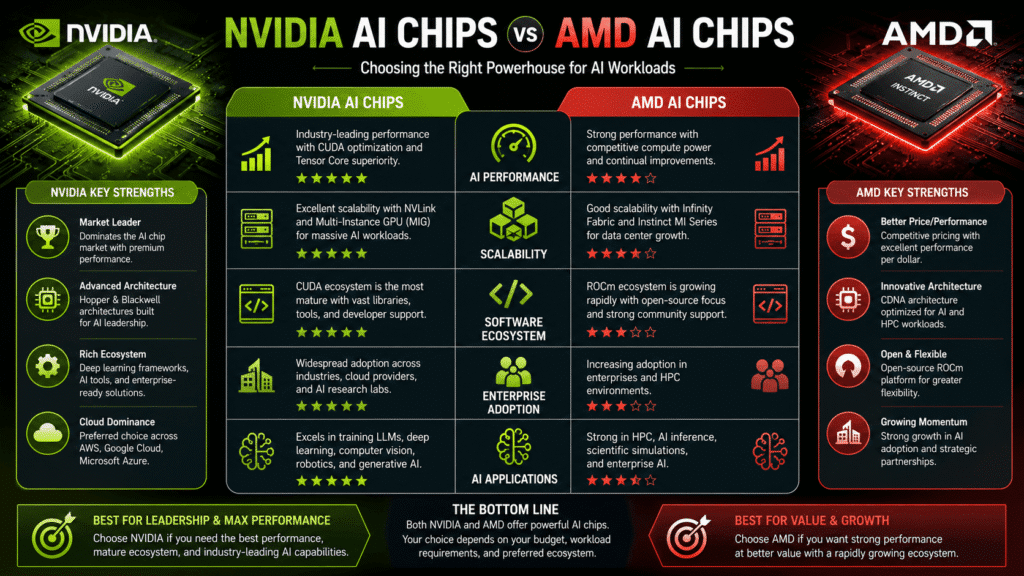
✔NVIDIA AI Chip vs AMD AI Chip
| Feature | NVIDIA AI Chip | AMD AI Chip |
|---|---|---|
| AI Ecosystem | Mature and widely adopted | Rapidly growing |
| AI Software Support | Extensive | Expanding |
| Data Center Adoption | High | Increasing |
| Scalability | Excellent | Competitive |
| Enterprise AI Usage | Widely deployed | Growing rapidly |
| AI Infrastructure | Advanced | Strong emerging solutions |
Both NVIDIA and AMD are investing heavily in AI hardware technologies, giving organizations more options when selecting AI infrastructure.
✔AMD AI Chip: A Growing Competitor
AMD AI chips are becoming increasingly competitive in the AI hardware market.
Their strengths include:
- High-performance computing capabilities.
- AI accelerator technologies.
- Data center solutions.
- Enterprise-focused AI platforms.
AMD continues to expand its presence by delivering AI hardware designed for large-scale computing environments.
Organizations evaluating AI hardware should consider:
- Workload requirements.
- Software compatibility.
- Infrastructure costs.
- Scalability needs.
- Long-term deployment goals.
✔Choosing the Right AI Chip
Selecting the best AI chip depends on several factors.
🔹Consider Performance Requirements
Ask yourself:
- Are you training large AI models?
- Do you require real-time inference?
- Will workloads scale significantly?
🔹Evaluate Software Support
Software compatibility is critical for:
- Development workflows.
- AI frameworks.
- Enterprise deployments.
🔹Consider Scalability
AI projects often grow over time. Choosing scalable hardware can help support future requirements.
🔹Budget Considerations
Organizations should evaluate:
- Infrastructure investments.
- Power requirements.
- Deployment environments.
- Maintenance considerations.
Read More ➡ Create a Roblox Game: A Beginner’s Guide to Building Your First Roblox Experience
✔Benefits of AI Chips for Businesses
Businesses adopting AI hardware may experience benefits such as:
- Faster AI model development.
- Improved computational efficiency.
- Enhanced scalability.
- Better AI application performance.
- Increased innovation opportunities.
AI chips are increasingly becoming essential infrastructure for modern AI initiatives.
✔Future of NVIDIA AI Chips
The demand for AI computing continues to grow across industries.
Future developments are expected to focus on:
- Larger AI models.
- Improved energy efficiency.
- Faster AI processing.
- Expanded enterprise adoption.
- Enhanced cloud AI infrastructure.
NVIDIA remains one of the leading innovators shaping the future of AI hardware technology.
✔Frequently Asked Questions (FAQs)
➖What is an NVIDIA AI chip?
An NVIDIA AI chip is specialized hardware designed to accelerate artificial intelligence and machine learning workloads across data centers, cloud computing, and enterprise environments.
➖What are AI chips used for?
AI chips are commonly used for:
- Machine learning
- Generative AI
- Robotics
- Autonomous systems
- Scientific computing
- Natural language processing
➖Is NVIDIA better than AMD for AI?
Both companies offer powerful AI hardware solutions. The best choice depends on performance requirements, software ecosystem compatibility, scalability needs, and deployment goals.
➖Why are AI chips important?
AI chips significantly improve the speed and efficiency of training and running artificial intelligence models.
➖Can AI chips improve business performance?
AI hardware can accelerate AI applications and support advanced computational workloads across multiple industries.
➖Are AMD AI chips becoming more competitive?
Yes. AMD continues to expand its AI hardware capabilities and is increasingly competing in enterprise and data center AI markets.
🎯Conclusion
The NVIDIA AI chip continues to play a major role in advancing artificial intelligence technologies worldwide. Its powerful architecture, broad industry adoption, and scalable AI infrastructure make it an important component of modern AI computing.
At the same time, AMD AI chips are emerging as strong alternatives, giving businesses more flexibility when building AI-powered solutions. Understanding your workload, software requirements, and scalability needs will help you choose the most suitable AI chip for your organization.
Whether you’re exploring generative AI, cloud infrastructure, or enterprise AI deployments, investing in the right AI hardware can significantly impact performance and future growth. 😎📧